Bridgeport's Best Bat Removal
We've been voted Bridgeport's best bat removal company the past two years!
Get in touch
Bat Experts
Rapid Response
Trained & Educated
Licensed & Certified
About Bridgeport Bat Removal
Welcome to bridgeportbatremoval.com. We are the only qualified bat removal company in Bridgeport, Connecticut. Animal removal professionals can deal with a range of different pest animal problems, but one of the more unique skill sets is that which they use when they are dealing with a bat infestation in an attic or loft space. Naturally bats are airborne so they use different access points, but they also only eat live prey so they cannot be poisoned, so a different approach to the problem is required. All of our technicians are fully trained to be able to remove any bat colonies that may be present, and to do so in an efficient way that will not harm any of the bats, simply remove them and force them to find another place to roost. Once you have booked one of our experts to visit your property, they will inspect the colony and the situation, so that they can find the access points and plan the exclusion steps that will allow the bats out of the property, but then stop them from getting back in. Having excluded all of the bats, we can also provide services to clean the attic or loft space and safely remove any soiled insulation, as well as carrying out any repairs needed. We can also offer to fumigate the space with an airborne disinfectant that will completely remove any risk of disease transmission from the remaining particles left in the attic. We operate 24-7-365, so don't hesitate to call us at 475-225-2001 to discuss your bat problem and schedule a fast appointment.
Residential
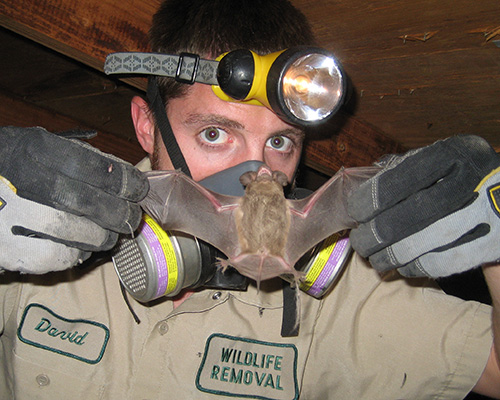
We are experts at removing bats from residential properties. Whether you have a single bat trapped in your house, a colony roosting in your attic, and/or various other problems, there is no need to worry! During our removal process, we make sure to inspect your entire home carefully, tracking down all the entrypoints bats are using to invade your place. Next, we perform a process called live exclusion (where no bats are harmed and all exit your property), then seal all entry holes completely shut. We also take care of the cleanup process after, so your home is safe and clean!
Learn MoreCommercial
Besides residential areas, we also have a wealth of experience removing bats from commercial properties! We begin by investigating the area for possible bat entrances, covering holes even as small as 1/4 of an inch. Through our live exclusion process, bats leave the building through one-way exits, and we seal up every hole afterward. Once the bats have been removed, we perform a cleanup process. This includes dealing with guano, replacing damaged insulation, and decontaminating the place.
Learn More
Contact us for bat removal today!
What Our Customers Say
I had a bat flying around in my house at 9pm, and CITY bat removal came right out and caught it in a net.
Sarah Lakewood
I had an annoying colony of bats stuck in my attic for a while before I finally decided to call for help. They were able to quickly and thoroughly solve the problem!
Brandon Chung
They did a great job clearing my attic of bats and didn't hurt any of the creatures.
Charlotte Demers
The technicians at CITY Bat Removal are skilled, professional, and know exactly what they're doing. Would highly recommend.
Mark O'Connor
My house stank of bats and their guano inside my wall. CITY Bat Removal not only removed the bats, they also got rid of the smell!
Alexis Ramirez
.jpg)
How Do Bats Use Echolocation?
Bats are nocturnal creatures that do most of their daily activities, such as feeding and travel, during the night. As such, their eyesight has been enhanced with a sense called echolocation. In short, that means they can see with sound. Their ability to find objects based on how they reflect sound and build a picture of their environment is complemented by their ability to see in low-light conditions, such as dusk, dawn, and moonlight.
What Is Echolocation?
They emit a high-frequency sound, using squeaks and chirps, to perform this echolocation. The closer an object is, the echo or reflection of sound is louder and returns sooner. The longer the reflection takes and quieter it is means that the object is further away. Bats can detect what sort of surface it is based on the changes in the phase of the echo. This lets them determine whether it is a hard wall, tree, bush full of leaves, or tiny insect.
Bats can do this by knowing how fast they are traveling and using different types of squeaks. They process information like echo harmonics, rate, length, intensity, and components of the call which are all controlled by the bat. It can vary between species as to how they use the different types of calls and sounds.
Frequency of Sounds
Bats can make high-frequency sounds that give the most detail but are only accurate over short distances and low-frequency sounds that give much less detail but have a longer range. Although the highest kilohertz recorded was 212 kHz, most bats produce sounds between 20 to 60 kHz. In comparison, humans can only hear up to 20 kHz. The reason for the range depends on what the bats are doing. Sound at 20 kHz is too large of wavelengths to detect insects because they are small, and it passes around them. On the other hand, frequencies above 60 kHz are much weaker in the air.
Different Calls
Bats use two different kinds of sounds: narrowband and broadband. Narrowband calls are at a constant frequency and are used as a search method for identifying potential prey. Broadband calls sweep across a large range of frequencies in a short amount of time providing a better layout of the landscape. As they get closer to their potential prey, the search calls get faster and faster until the prey is caught and consumed.
Talk or Listen
During the process, there is a "duty cycle" which is a portion of time spent generating the sound used for echolocation. Generally, most bats cannot listen for echoes if they are making sounds too. There is one species that can, which shortens the amount of time spent making sounds. As a result, they can hunt more often. With their uniquely developed echolocation, bats can sense an object in motion from the sounds that return from their calls.
Physical Developments
To make the range of sounds for echolocation, a bat's voice box is large and reinforced with bone. This allows a higher tension to be put on their vocal cords so they can make those high-frequency vibrations. The sounds are produced in a beam that is directed through a gap in their upper incisors. Some species have a flap of skin on their nose that concentrates the stream of sound pulses and can provide extra sensitivity. That means it extends the range from the average of one meter to around ten. Their ears relax to better process the echoes and they have a spike of cartilage from the base of the ear for better sound detection.
Different Bats
Echolocation is generally a characteristic of microbats, which are the most common type of bat. They are small insect hunters and makeup approximately 70 percent of the entire population of bats. There are a few exceptions of megabats, those that eat fruit, that have better eyesight for finding their next meal. Flying foxes are one version of megabats that have great eyesight. There is only one of the megabat species that uses echolocation so they can safely navigate tunnels in both daylight and nighttime.
Baby Bats
Newborn bats pick up echolocation rapidly. At 2 weeks, they can create sporadic narrowband and broadband calls. At around four weeks they are more sensitive to sounds of moving objects and can track potential prey. The development of their call structure changes according to geography and has a potential relation to food sources.